synthesis engineering
60 articlesChecking a ChatGPT research report against its sources
Check a ChatGPT research report by matching consequential claims to primary sources, preserving conditions, and testing what its recommendation depends on.
Delegate the work, not the working pattern
AI agents need working patterns built around real dependencies and human judgment, not inherited office habits. Parallel work and meeting preparation show why.
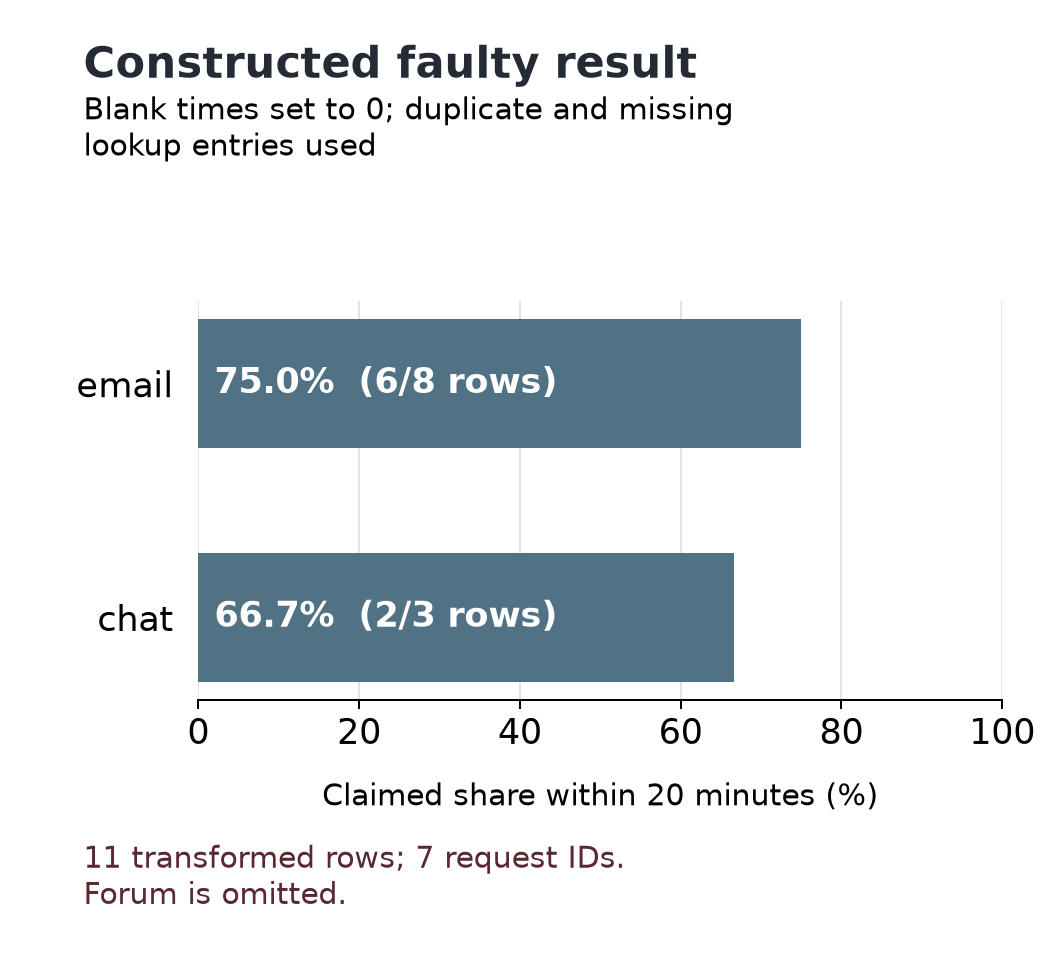
From CSV to chart: reviewing ChatGPT’s data analysis
Check a ChatGPT analysis from the original CSV rows through joins, missing values, and denominators, with an example you can calculate and reproduce yourself.
Hook configuration: three probes and a trust check
Three historical hook configurations show how diagnostics guide the next experiment, with both workspace trust and the captured result checked separately.
Testing an installed plugin after its hooks run
A Python bytecode failure shows how to test an installed plugin after hook execution, while checking package integrity and application results separately.
The Action Sheet: one page for everything your AI agents still need you to do
The decision packet's companion: after AI agents act on your rulings, one page shows what's done, what waits for your approval, and what's left for you, with th
Two vendors, one standard: running a real upgrade with synthesis engineering
An upgrade with Claude and Codex exposed a disabled safeguard and an invisible project record. The repairs show how to test the workflow that actually runs.

The Decision Packet: batching AI agents' questions without rubber-stamping them
Batch AI agents' questions into one clear review page, preserve exceptions and deliberate choices, and keep each answer tied to its evidence and authority.
The migration that was finished until a stranger looked
A synthesis engineering story about Blind-Spot Rotation: how an AI reviewer with fresh context can find gaps the original inventory and checks missed.
Choosing Local AI Models by Measuring the Machine
Profile a computer, choose local open-weight models that fit, install them safely, and map exact artifacts to each machine with a reproducible workflow.
Why I built synthesis engineering to work across AI runtimes
Why synthesis engineering separates model, runtime and state portability, preserving native strengths while keeping projects and methods under your control.
My AI executive assistant writes in its own voice. My AI chief of staff writes in mine.
Ragbot and Ragenie, EA AI and chief-of-staff AI: why my executive assistant agent writes in its own voice while my chief of staff agent writes in my voice.
My design record ruled out agent-to-agent messaging. Six days later I shipped it.
I documented why session-to-session agent messaging would fail, then built it six days later. Why a design record is not a constraint, and what actually is.
What agent memory research taught me about twenty years of notes
Tiered memory for a personal knowledge base: what MemGPT, Zep, and Mem0 teach about structuring two decades of notes so AI agents find the right ten files.
AI tools should copy GitHub's identity model, not your employer's
AI tools should give people lasting identities and organizations scoped roles. My GitHub account and shared-agent schema show why that design choice matters.
What should survive when you change AI tools
Preserve project decisions, methods, authority and evidence across AI tools, with explicit ownership of the adapters and tests that keep the work portable.
A green config is not a working agent
Check source, installation, live behavior, continuity and capability. Use native client adapters and shared outcome tests to earn trust in an AI environment.
I gave my AI agents a chief-of-staff job description
AI agents as chief of staff: how I encoded absence coordination, notification tiers, send gates, and silent-failure validators into open-source config.
Ask Your AI to Refute You
Commission AI reviewers to challenge your claims, then test their findings. Use distinct lenses, concrete counterexamples and honest unresolved states.
AI disclosure guards: approval is the boundary
Build AI disclosure guards around approved facts, their sources and where they will appear, with a precedent ledger and five practical contextual review tests.
Your AI assistant’s memory should belong to you
Check whether AI memory survives a change of tool or machine, using my 35-file audit and a practical handoff test for a durable, versioned project record.
I built a validator for Google’s Open Knowledge Format
Check an OKF v0.1 bundle against its specification, distinguish checker coverage from conformance, and preserve knowledge and navigation during conversion.
When I use chat, workflows, and a visual console
How I choose between chat, repeatable workflows and a visual console, while keeping project records I own and deciding what must survive a change of tools.
An Iron Man suit for the mind
AI can make us faster while we keep the architecture, judgment, thinking, and learning. My conversation with Dan Blumberg explains how I put that into practice.
Synthesis engineering needs a pedagogy, not just a methodology
A methodology tells practitioners what to do. A pedagogy forms judgment. What the Bauhaus teaches about growing synthesis engineering beyond its founders.
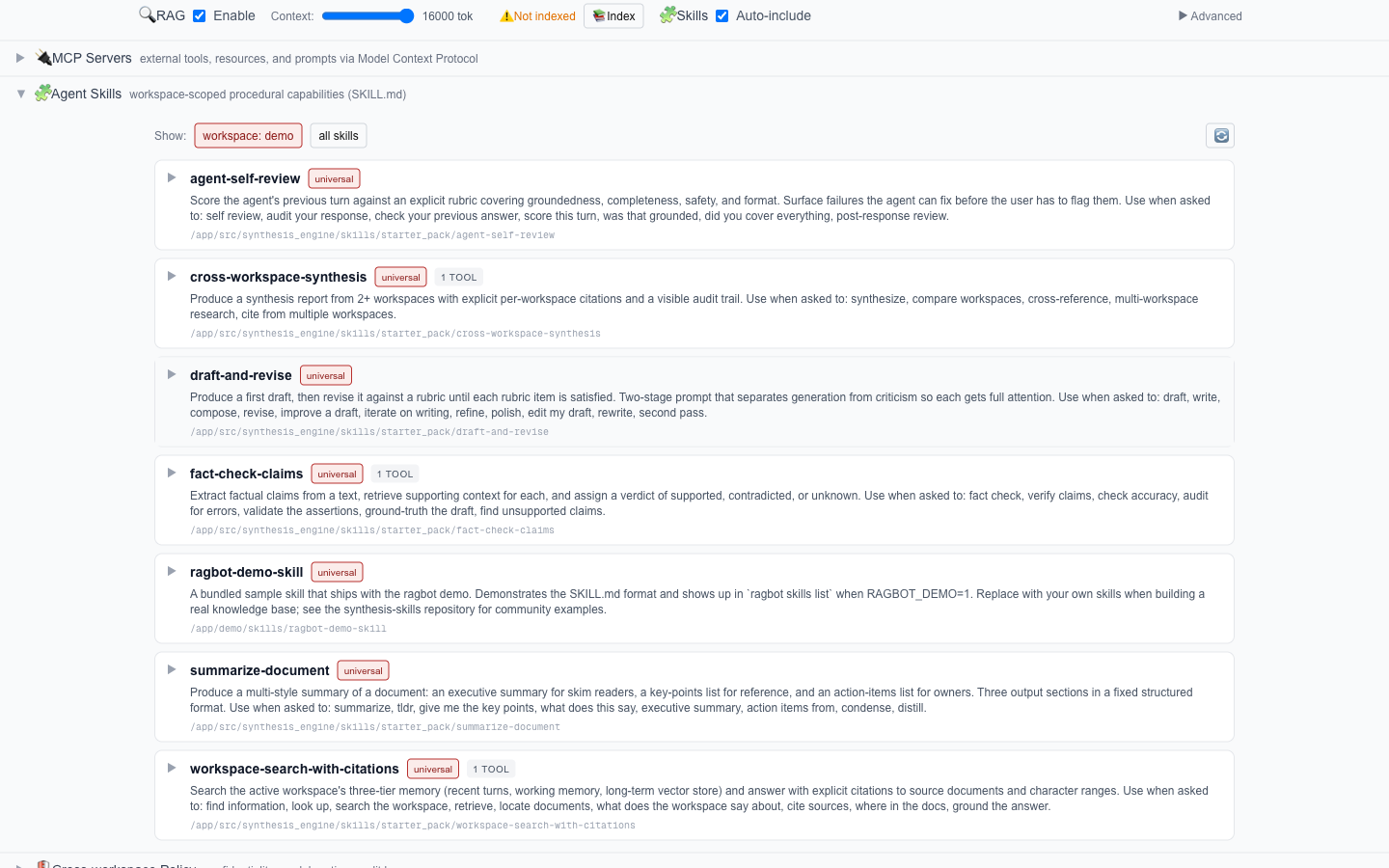
Three Ragbot releases, one architectural shift
How Ragbot’s three releases joined local models, tools, skills, memory and policy into a conversational runtime, with the engineering choices behind the shift.
Directing an AI assistant across search and hosting tools
Directing an AI assistant through Search Console, Bing and Cloudflare kept a recovery moving while I made the decisions, checked results and managed exceptions.
I made project memory portable between Claude Code and Codex
Carry project decisions, unfinished work, and verification between Claude Code and Codex while checking each tool's instructions, skills, hooks, and access.
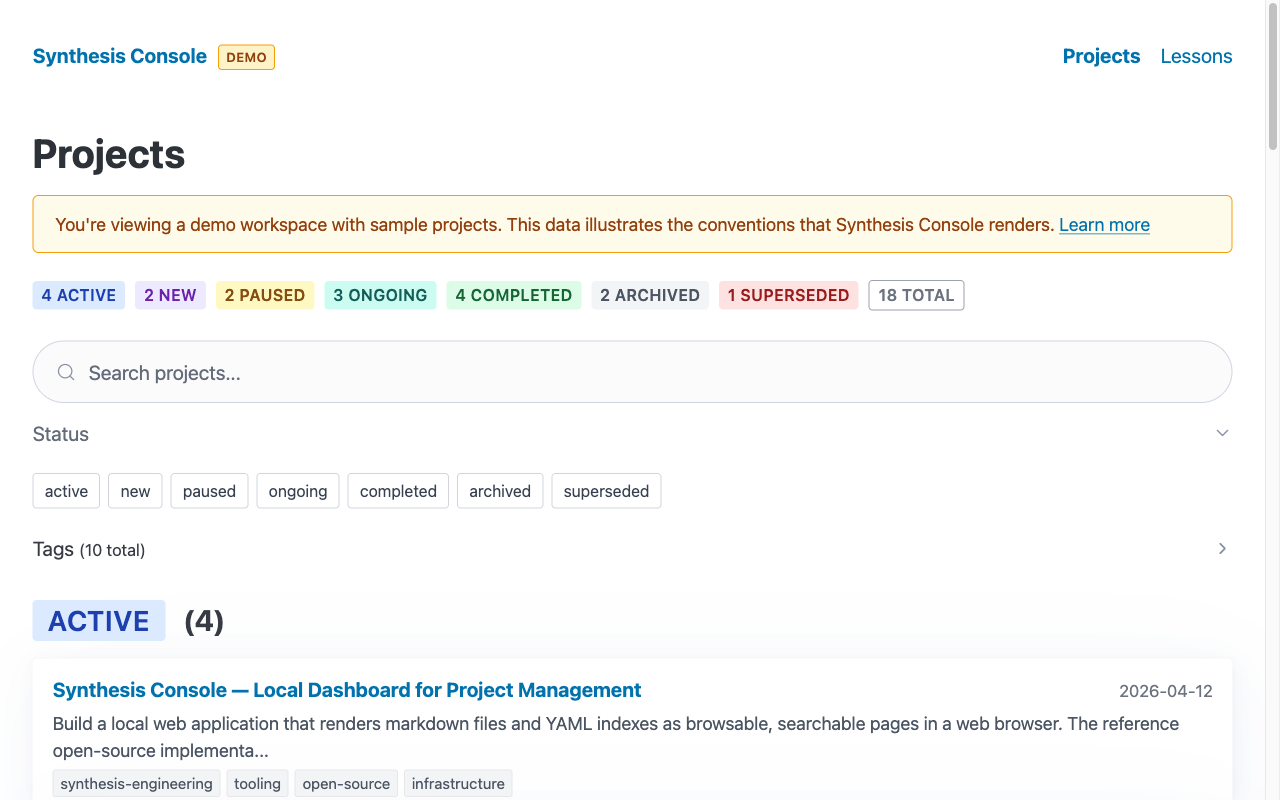
Synthesis Console: open-source tooling for synthesis engineering
I built a local console for projects, lessons and daily plans. File conventions, a small dependency budget and portable configuration shape its architecture.
The synthesis thinking framework: a practitioner's guide
Apply five thinking modes to architecture, integration and daily AI collaboration, with cases connecting engineering decisions to a working methodology.
Thinking through a strategic decision with AI
Five questions help leaders examine assumptions, consequences, uncertainty, analogies and user needs with AI before committing to a strategic decision.
Synthesis Skills: install methodology directly into your AI workflow
Install reusable Synthesis Skills for code review, writing, and project continuity, with current setup guidance and the lessons behind the original release.
Who keeps the AI dividend?
AI productivity gains flow to employers while workers get more work for the same pay. Evidence from BCG, NBER, and labor economics shows why sharing matters.
The Tiered Context Architecture: Managing AI Working Memory at Scale
Organize AI project memory into active work, reference and history, with a worked migration, recovery checks and a practical path toward compiled context.
When AI summaries become your sources
Keep AI summaries useful as they become organizational knowledge: preserve decisions, check their sources, and build context your teams can trust and improve.
Verifying AI-Written Code with Independent Checks
Use independent expectations, parser comparisons, staged probes and reviewed dry runs to find mistakes in AI-written code before acting on its output.
Why AI makes engineering discipline more valuable
Richard Socher’s work on managing AI informs a practical framework for engineering leaders: architecture, delegation, code review, team skills and adoption.
Bidirectional Learning in Synthesis Coding: When Human and AI Teach Each Other
Bidirectional learning in synthesis coding: humans teach AI through context, prompts, and review; AI teaches back by surfacing blind spots and edge cases.
The research lineage from recursive neural networks to human-AI collaborative development
Richard Socher's work on representations and language-based tasks suggests five research questions for building reliable software with human-AI collaboration.
From learned representations to engineered context: what Richard Socher's research tells us about working with AI
Richard Socher's work on reusable representations offers a practical lens for persistent AI coding context, architectural foundations and disciplined review.
Code Review That Scales: Choosing Review Depth by Risk
Use a tiered code-review runbook to choose review depth, override the tier for consequential risks, and record what was checked, excluded or left unverified.
Richard Socher nailed the future of work with AI
Richard Socher identified the skills that matter in the AI era: delegate clearly, specify requirements, build trust. These are learnable skills, not job titles.
Why Engineering Judgment Matters More With AI
AI makes engineering judgment more valuable. Four experiences show how faster implementation changes refactoring, verification and what we choose to build.
What Agent Engineering and Synthesis Engineering Share
LangChain's agent engineering and my synthesis engineering framework share a production discipline. A support-agent example shows how to use them together.
Diagnosing Retrieval Failures in a RAG Application
Use Ragbot’s biography lookup to separate routing, tokenization and ranking, then trace a context-budget change through five defaults from UI to retrieval.
Keeping Claude Code Refactors Consistent Across Long Sessions
Keep a long Claude Code refactor aligned with its conventions through instruction-loading checks, scoped code review and tests of the behavior being changed.
From Tool to Team: Managing AI as Distributed Engineering
Parallel coding agents make engineering leadership central: define work, share context, review results and integrate changes while retaining design judgment.
Synthesis Project Management: Keeping AI Work Moving Across Sessions
A working method for human-AI projects: keep current context small, preserve decisions and lessons, and carry useful work across sessions, people and AI tools.
Synthesis Engineering: Organizing Complex Work with AI
A discipline for organizing complex work with AI: define results, assign responsibility, check outcomes and preserve decisions, with a worked software example.
How Claude Code Uses CLAUDE.md and Memory
Claude Code loads project instructions and saved memory under different rules. Check what survives compaction and whether the code follows your guidance.
What OpenAI's Sora Build Teaches Us About Synthesis Coding
What OpenAI's Sora Android case teaches about synthesis coding: give agents context, establish patterns, plan changes, and lead the work as it scales.
Scaling Synthesis Coding in Your Organization
Scale AI coding through a phased team rollout, role-specific training, quality standards and practical measures that build lasting engineering capability.
Why Synthesis Coding Still Writes Code in the Age of LLMs
Why better AI strengthens the case for code, shared understanding and review, with a family math puzzle, a runnable median example and three practical prompts.
Vibe Coding and Synthesis Coding: Two Complementary Approaches
Use conversational exploration to test ideas and synthesis coding to build software people can depend on, with practical guidance for moving between the two.
Polyrepo Synthesis: Working Across Repositories with Claude Code and VS Code
Configure Claude Code and VS Code for cross-repository work, map shared dependencies, and test both direct and indexed consumers after a schema change.
Modernizing a 17-Year-Old WordPress Plugin with Claude Code
A 2025 modernization of Blogroll Links: WordPress security and compatibility work with Claude Code, and why maintaining open-web software still matters.
Reviewing Claude Code’s Work: Security and Performance
Four Claude Code cases show how engineering review improves authentication, caching, async calls, and security findings, with runnable local Python examples.
The synthesis coding framework: building production software with AI
Five connected pillars turn AI-assisted coding into an organizational practice, with project cases, planning guidance, and a path to production software.
Synthesis coding: a professional practice for AI-assisted development
Architectural judgment, systematic quality, and shared project knowledge make AI-assisted development a professional practice with lasting value for teams.
The Future of Engineering Services: Building and Measuring Human-AI Teams
How engineering services can move from hours to capabilities, with human–AI team structures, outcome measures, client examples, and ways to price the work.