practice
17 articlesTwo vendors, one standard: running a real upgrade with synthesis engineering
A real three-day upgrade with two AI vendors exposed the Built/Deployed Gap: controls and records that passed checks but never reached the running system.

The Decision Packet: batching AI agents' questions without rubber-stamping them
A synthesis engineering pattern for staying in command of AI agents at speed: collect every decision they owe you into one honest, reviewable page.
Choosing Local AI Models by Measuring the Machine
Profile a computer, choose local open-weight models that fit, install them safely, and map exact artifacts to each machine with a reproducible workflow.
My design record ruled out agent-to-agent messaging. Six days later I shipped it.
I documented why session-to-session agent messaging would fail, then built it six days later. Why a design record is not a constraint, and what actually is.
I gave my AI agents a chief-of-staff job description. The hard part was the org chart, not the code.
AI agents as chief of staff: how I encoded absence coordination, notification tiers, send gates, and silent-failure validators into open-source config.
Honest labels for AI-assisted correspondence
Honest labels for AI-assisted correspondence: three lanes that tell recipients whose words they're reading, from executive staff practice to Ragbot and Ragenie.
The AI agent that deleted 474 of my files was right. I checked anyway.
An AI agent deleted 474 files and its report was accurate. Verifying an agent's summary, not just its work, is the discipline that catches the divergence.
A Warning That Doesn't Block Is a Bug
A pre-commit guard printed its own failure and passed the commit anyway. The fix for the class: fail closed, carry a doctor, spend false alarms like currency.
I built the conformance validator Google's OKF repo didn't ship
Google's knowledge-catalog repo shipped no standalone OKF validator, so I built a checker for the format's three hard rules. Open-sourced as synthesis-okf.
Your coding agent should watch its own work run
Your coding agent should watch its own work run: browser automation like Playwright turns 'it should work' into 'I watched it work' with evidence attached.
Slop detection, not AI detection
A free, open-source tool that reads content along two axes: AI-provenance signal and slop-independence. Built for editors, writers, and anyone deciding what is
Every bug report is now a patch-or-redesign decision
The minimal patch is a habit from when understanding was expensive. AI coding agents ended that economy, and most of us never consciously make the choice.
The Direction Dynamic in ops: driving multi-tool recovery through a single AI session
The technical fix was the easy part. The recovery was tedious GUI work across Search Console, Bing Webmaster, and Cloudflare. I drove all of it through one Clau
Postel's Law for the human-AI interface
When one end of a software contract is an LLM, Postel's Law isn't a courtesy — it's load-bearing. The shape that lets you ship: document-as-contract.
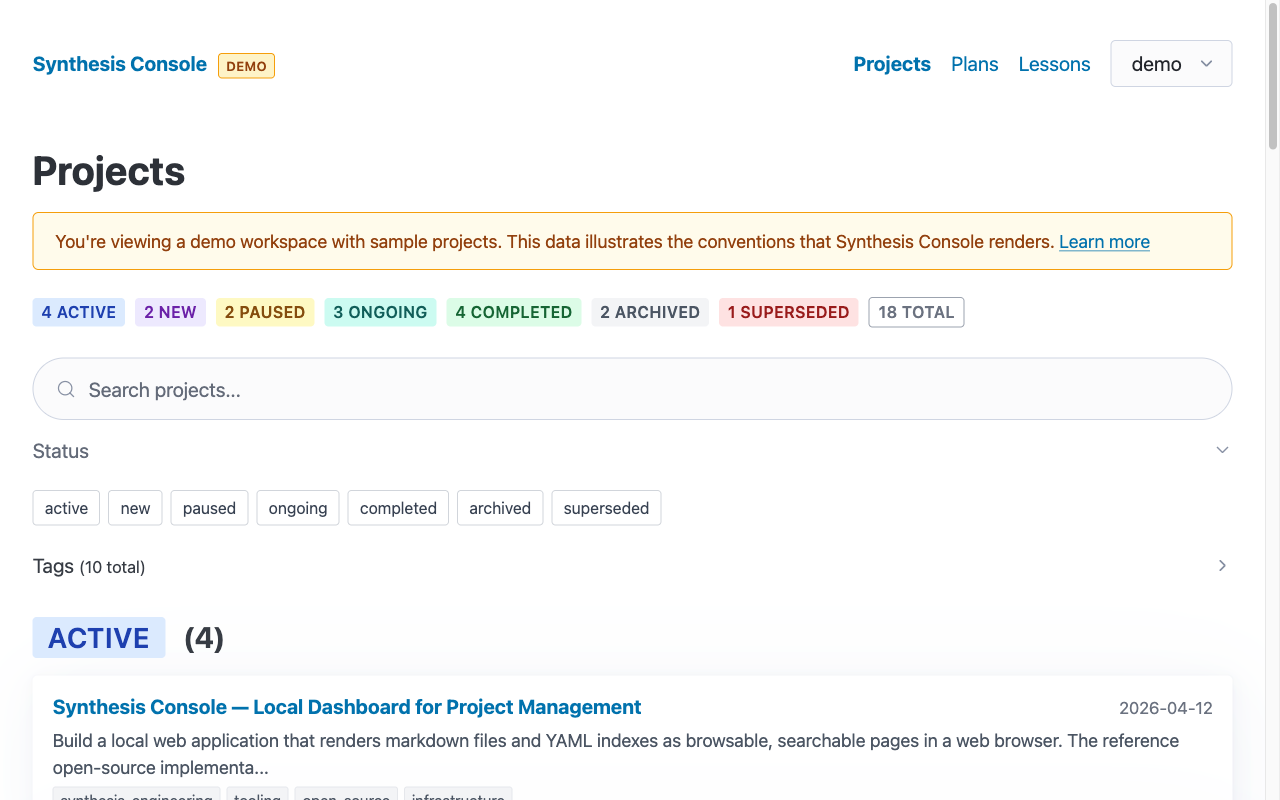
Demo mode as a pattern for software
Ship every software product with built-in demo mode. The pattern serves authors, users, sales teams, and compliance — and synthesis engineering makes it cheap e
Stop asking me: configuring Claude Code permissions for uninterrupted flow
A practitioner guide to eliminating Claude Code approval prompt fatigue. Why granular command patterns fail for compound commands, the Bash(*) plus deny list ap
The blast radius principle: defensive patterns for AI-generated commands
Every command an AI assistant proposes has a blast radius: the worst it can do if wrong. Dangerous shapes, safer forms, and a three-tier safeguard hierarchy.