In the role of chief technology officer, you have to be concerned with many topics. Some relate to functions you have direct supervisory responsibility for and some in areas that are managed by others but you still need to share responsibility for.
To keep all of a CTO’s concerns organized, I created this mind map using XMind. The items are classified under three major categories: culture, technology, and operations. This framework builds on the 3 Roles of a CTO that I published last year, which presents these same three areas as a structure for weekly 1:1 meetings.
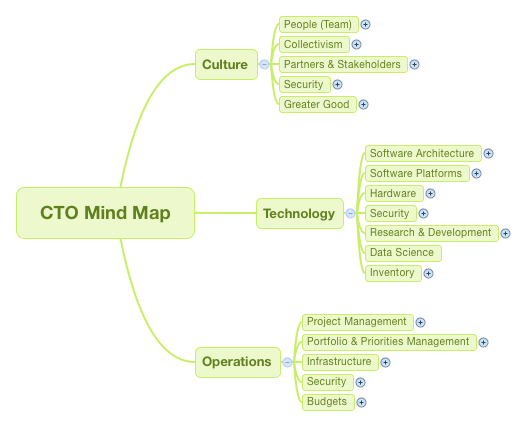 CTO Mind Map: Culture, Technology, Operations: High Level Summary View
The purpose of this mind map is manifold. It serves as a visual job description. It is a map for CTOs to use to prioritize and focus their own work and that of their team members, based on the organization’s needs and the skill sets available. It is also used to identify gaps, both in terms of areas and coverage.
What the Map Contains
The mind map has three major branches, each with sub-branches that capture the CTO’s areas of concern.
Culture covers the human side of leading a technology organization:
- People (Team) — hiring, retention, career development, performance evaluation, compensation, and the day-to-day well-being of your team
- Collectivism — building shared purpose, collaboration norms, knowledge sharing, and a sense of belonging across teams
- Partners & Stakeholders — relationships with other departments, executives, customers, and external partners who depend on or influence your technology organization
- Security — the cultural dimension of security: awareness, training, behavior, and shared responsibility for protecting the organization
- Greater Good — the organization’s responsibility to the broader community, open source contributions, industry participation, and ethical technology practices
Technology covers what the CTO’s teams build and maintain:
- Software Architecture — system design, API strategy, microservices vs. monoliths, integration patterns, and technical standards
- Software Platforms — the tools, frameworks, and platforms your teams build on and deliver through
- Hardware — physical infrastructure, devices, and the intersection of hardware and software
- Security — the technical dimension: vulnerability management, encryption, access control, compliance, and incident response
- Research & Development — emerging technologies, experimentation, proof of concepts, and staying ahead of the technology curve
- Data Science — analytics, machine learning, data engineering, and turning data into products and decisions
- Inventory — tracking what systems, applications, and technical assets you own and their current state
Operations covers how the work gets done and delivered:
- Project Management — execution methodology, delivery cadence, estimation, and tracking
- Portfolio & Priorities Management — deciding what to work on, what to stop working on, and how to allocate resources across competing priorities
- Infrastructure — production environments, hosting, monitoring, deployment, and reliability
- Security — the operational dimension: incident response procedures, access management, audit, and compliance operations
- Budgets — financial planning, vendor management, cost optimization, and making the case for technology investment
You will notice that Security appears in all three branches. This is intentional. Security is not a single team’s responsibility. It is a cultural practice, a technical discipline, and an operational process, all at once.
How to Use This
If you are a new CTO, use this mind map in your first 90 days to identify which areas you understand well, which areas you need to learn, and which areas have no one covering them in your organization. The gaps are where the risk lives.
If you are an experienced CTO, use it as a periodic self-audit. Print it, mark each area with a color (green for strong, yellow for adequate, red for weak), and you have a visual dashboard of your organization’s health.
I maintain this mind map on GitHub at https://github.com/rajivpant/cto-mind-maps where you can download the editable XMind source file and adapt it for your own organization.
You can also view the full mind map as a scalable vector graphic.
If you create versions of this specific to your industry or role, I would be glad to hear about it.