
These days many notebook computers and portable devices like USB drives are featuring fingerprint scanners which they advertise as biometric security.
I’ve never been a fan of using a fingerprint scan as the only protection for a computer.
Stolen or lost laptop
A lost or stolen laptop can carry its owner’s fingerprints on its smooth surfaces. Those prints are not secrets in the way a well-chosen password is. A 2002 study by Tsutomu Matsumoto and colleagues demonstrated that copies made from residual prints could fool all eleven fingerprint systems they tested.
With a strong password and disk encryption, stealing the laptop need not give a thief access to its contents. The thief may reformat the drive, leaving you with the hardware loss. If a fingerprint scan alone unlocks the account and the scanner accepts a copy, your data, your privacy and your peace of mind for years to come are at risk as well.
Forced access to your computer
Let us leave aside the cinema-like gruesome situation of a villain cutting off your thumb. Say you are sleeping in a shared college dorm. If your finger alone unlocks your laptop, a roommate or friend may be able to use it without waking you. A stronger person can also force your finger onto the scanner without needing you to reveal a password.
Later illustration: XKCD published “Security” on February 2, 2009. Its joke makes a related point: passwords can be coerced too.
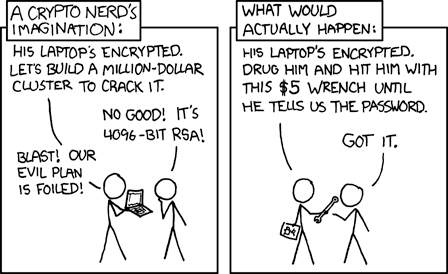
“Security” by Randall Munroe, XKCD, CC BY-NC 2.5.
Replacing passwords with fingerprint scanning alone can create a false sense of security. I would use a fingerprint scanner alongside a strong password and encryption. The advertising should make that distinction clear.
As an aside, here is an interesting article on how fingerprint scanners work at HowStuffWorks.com.