Recently, I’ve been thinking about what I’ve accomplished1 and what I still want to do. A parting message from my school days keeps coming back to me.
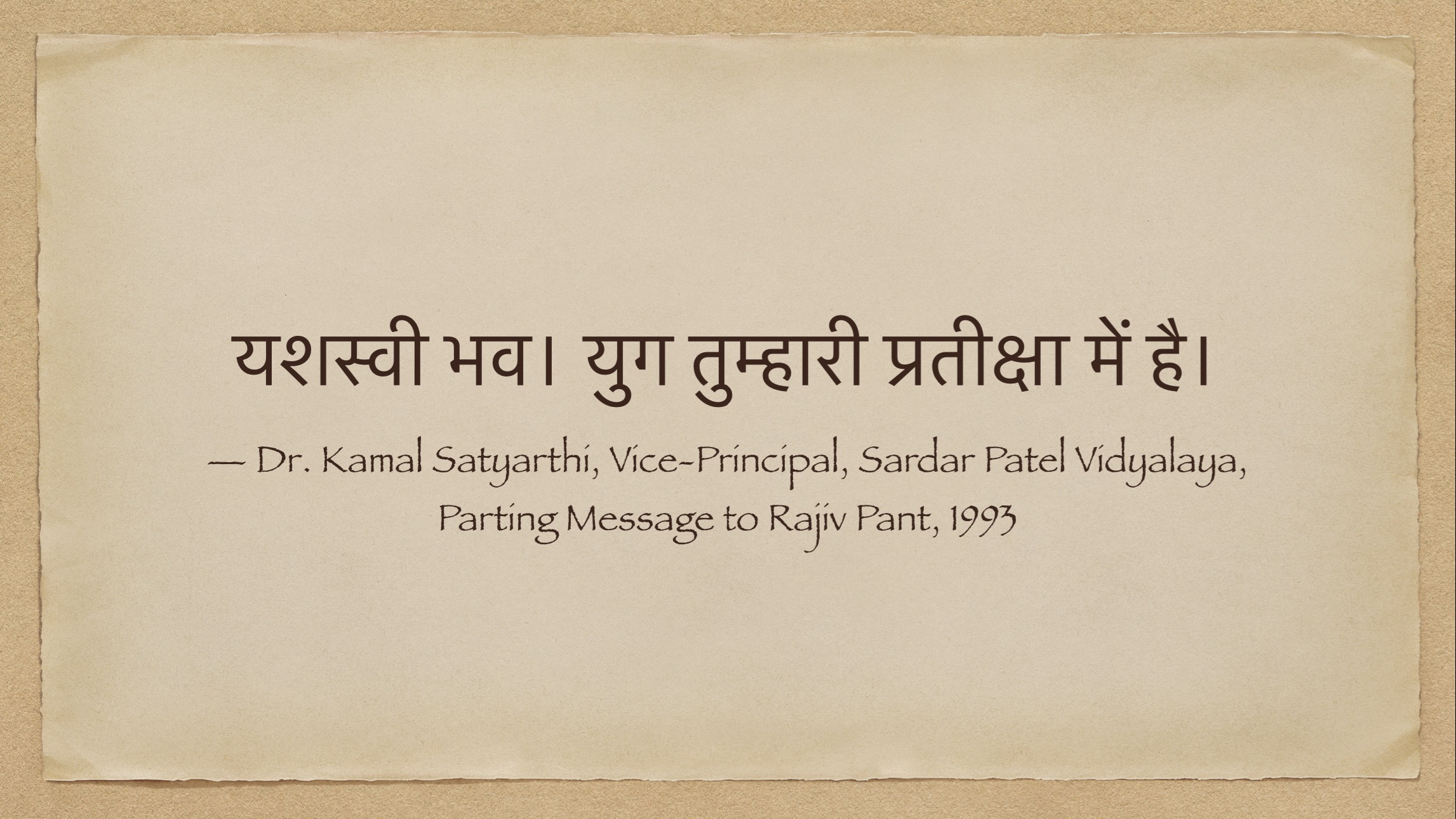
Dr. Kamal Satyarthi, then Vice-Principal of my school, Sardar Patel Vidyalaya, penned the following words in my notebook in beautiful Devanagari as I was leaving school:
यशस्वी भव। युग तुम्हारी प्रतीक्षा में है। (Be successful. The era awaits you.)
— Dr. Kamal Satyarthi, then Vice-Principal, Sardar Patel Vidyalaya, Parting Message to Rajiv Pant, 1993
In reply to my message on a WhatsApp group with my classmates from our school days, my friend Vinod recently reminded me that greatness doesn’t always manifest in grand gestures or historical milestones. Achievements can be found in our careers, in our roles as parents2, friends, and contributors3 to our communities4. This recognition of accomplishment in the everyday aspects of life is both grounding and inspiring.
But those words from Dr. Satyarthi still echo, urging me to consider the possibility of achieving something more, something that resonates beyond my immediate circles.
Time is limited. My urgency comes from wanting to make the most of the opportunities and talents I’ve been given, not from my age or an impending milestone.
I am not driven by a sense of destiny but motivated by a desire to live up to the inspiration found in Dr. Satyarthi’s message. It encourages me to strive, explore and do something worthwhile for the world.
Vinod reminds me that I can be proud of what I’ve done and still aspire to more.
Dr. Satyarthi’s words speak to a universal human aspiration: finding meaning, making an impact and growing as individuals and communities. I hope they encourage you, too.
An AI interpretation
I used Ragbot.AI, an AI Augmented Brain Assistant I developed, to explore Dr. Satyarthi’s message. Ragbot supports models including OpenAI’s GPT-4 and Anthropic’s Claude 2. Its retrieval-augmented generation (RAG) supplies information from my own files alongside the prompt, and it supports different custom instructions for different kinds of requests.
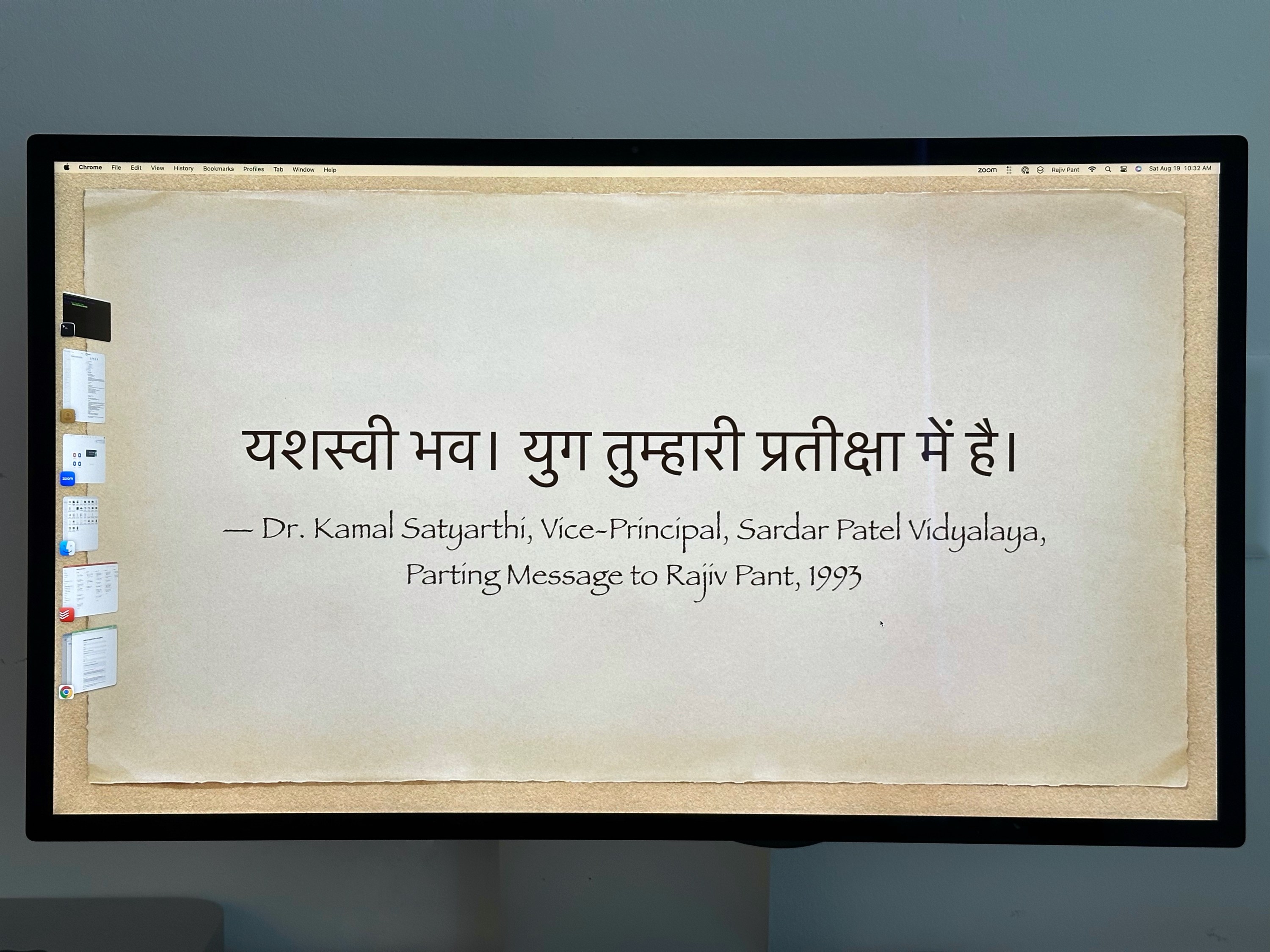 I posted this sign on my desktop for motivation.
My prompt to GPT-4
When I was leaving school in India, Dr. Kamal Satyarthi, then Vice-Principal of my school, Sardar Patel Vidyalaya, wrote the below line in my notebook as my parting message. Please explain what he meant. Go deeper beyond the literal translation.यशस्वी भव। युग तुम्हारी प्रतीक्षा में है।The opening is a Sanskrit blessing, and the following sentence is Hindi.5
GPT-4’s response
Certainly, let’s explore the meaning of the line written by Dr. Kamal Satyarthi in your notebook:
यशस्वी भव। युग तुम्हारी प्रतीक्षा में है।
Literal Translation:
- “Be Victorious. The era awaits you.”
Deeper Interpretation:
- यशस्वी भव (Yashasvi Bhava): This is not merely a wish for success; it’s an encouragement towards excellence and virtuous triumph. It signifies a belief in your potential and capabilities. The term reflects a desire for you to achieve greatness, not just in a material sense, but in a way that embodies integrity, honor, and dignity.
- युग तुम्हारी प्रतीक्षा में है (Yug Tumhari Prateeksha Mein Hai): This part takes the message a step further. The word ‘Yug’ can be understood as an era or a significant period in time. It’s not simply stating that opportunities await you; it’s emphasizing that an entire epoch or generation anticipates your influence and contributions.
Contextual Analysis:
Considering your educational background and subsequent achievements, the message can be seen as a profound acknowledgment of the potential Dr. Satyarthi saw in you. He was not merely wishing you success in conventional terms but was recognizing your ability to make meaningful impacts, perhaps even historical ones. The era “waiting” for you signifies the expectation that you will be a person who shapes the future, drives change, and leaves a lasting legacy.
The words chosen reflect a belief in your ability to rise above ordinary success and be a guiding light for others. It’s a poetic and timeless way to convey faith in your potential to be transformative, not just successful. In the context of your departure from school, it also encapsulates a sense of pride and expectation that you would carry the values and wisdom imparted during your education into the broader world.
The choice of Sanskrit, a classical and revered language, adds to the gravity and timeless resonance of the message. It connects the individual encouragement to a broader cultural and philosophical context, linking personal success with universal values.
In summary, this line is a profound and beautifully concise expression of faith in your potential to be not just successful but transformative and influential, grounded in values and integrity. It’s a message that seems to have been deeply prescient given your subsequent career and achievements.
Footnotes
-
On this Father’s Day, may your life be as marvelous as your social media presence ↩
-
Why I left being CTO of The New York Times, joined a startup, and am pledging 20% of my equity to charity ↩
-
I find joy in volunteering with charity organizations like New York Cares ↩
-
For the language distinction, see Learn Sanskrit’s imperative table, Hindwi’s entry for यशस्वी, and Rupert Snell’s Hindi drill patterns, page 2. ↩