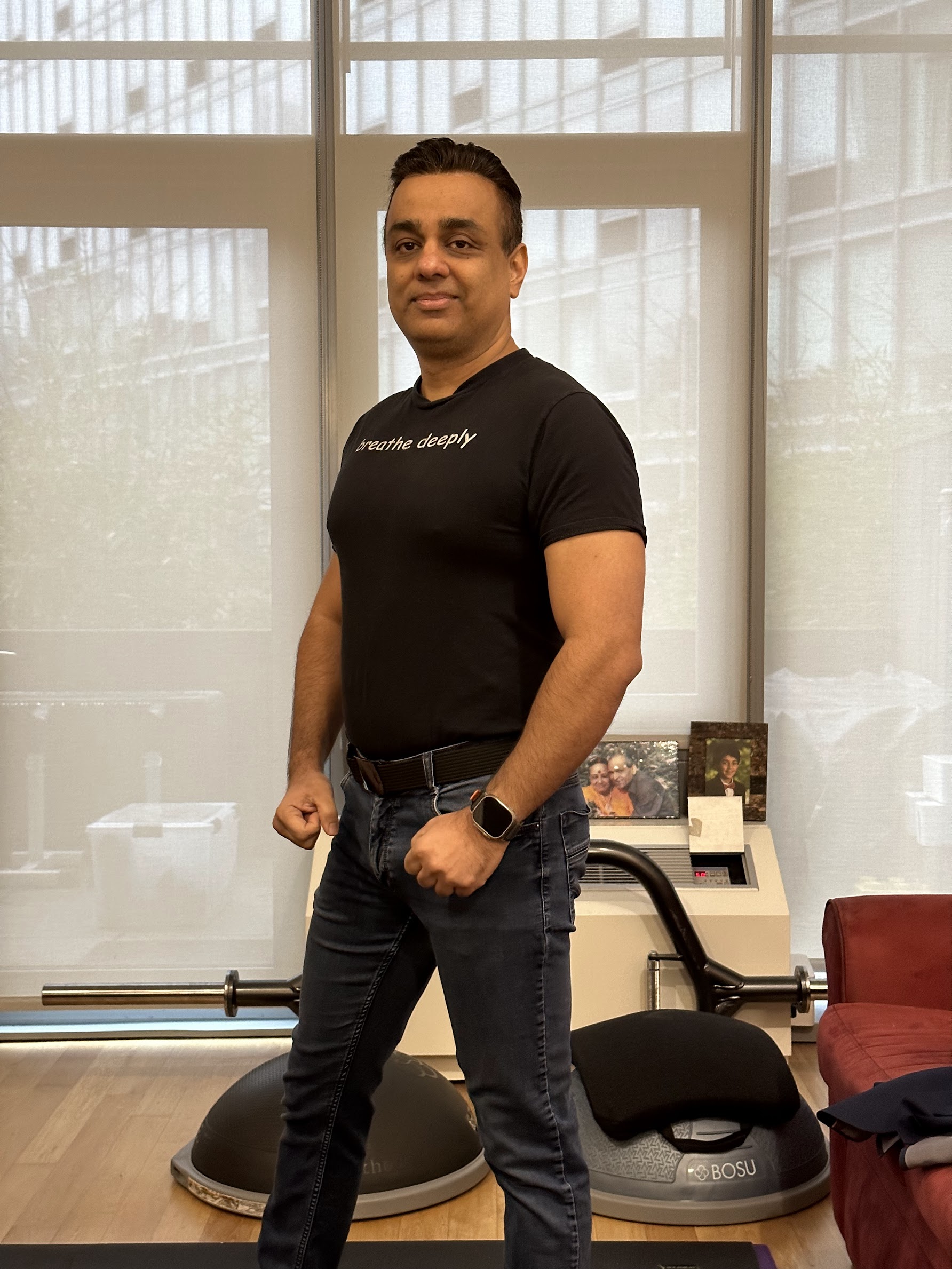
A few of my friends from growing up in New Delhi have a habit of referring to my daily training with my coach Julian as “bodybuilding.” I’ve corrected them more than once. It hasn’t stuck.
I think I understand why. In 1980s and ’90s Delhi, if you lifted weights, you were “doing bodybuilding.” That was the entire category. The reference points were Dara Singh, Arnold Schwarzenegger posters at the neighborhood gym, and the guys training for the Sheru Classic. Bicep curls under a bare bulb in a basement akhara — that was the image. There wasn’t a word for anything else.
But what I practice with Julian every day is something completely different. So I’ve started explaining it through analogies, because the direct explanation (“functional fitness focused on movement patterns and longevity”) makes people’s eyes glaze over. Fair enough. Here’s what works better.
The Mahindra Jeep
Bodybuilding is building a show car. You’re optimizing for how it looks on a platform — chrome everywhere, custom paint, massive engine you never actually rev. My training is more like maintaining a Mahindra Jeep. Not the prettiest vehicle on the road, but the suspension works, the engine is reliable, and it handles rough terrain without falling apart. One wins trophies sitting still. The other performs under real conditions for years.
One wins trophies sitting still. The other performs under real conditions for years.
The stunt double
Think about a 1990s Bollywood action film. The hero makes his dramatic entrance — shirt open, muscles oiled, the camera lingering on the physique. That’s bodybuilding. The actual stunt double — the person who needs real agility, core stability, and the ability to take a fall and get up and do it again tomorrow — that’s closer to what I train for.
The building
Nobody admires your foundation from the sidewalk. But it’s what keeps the building standing when things get rough. Bodybuilding is the facade renovation — marble pillars, symmetrical windows, fresh paint, impressive from the street. Functional fitness is what’s behind the walls: reinforced foundation, upgraded plumbing, a structure that can handle an earthquake.
The software
For friends who know what I do for a living, this one tends to land fastest. Bodybuilding is the pixel-perfect UI — every button placed just so, the colors pop, it looks stunning to anyone who sees it. What I do with Julian is more like backend architecture. Clean code, optimized database, resilient APIs. Nobody sees the work that went into it. But it’s what prevents the system from crashing under load.
The cricket match
How would you train if you had to sprint between wickets, dive for catches, bowl ten overs, and then field for a full day without breaking down? That’s functional fitness. A bodybuilder trains like someone perfecting their batting stance in front of a mirror. The pose itself is the goal. The mirror doesn’t care if you can actually play.
The mirror doesn’t care if you can actually play.
The luxury hotel
My friend Anshul, who’s spent his career in luxury hospitality, put it in terms from his own world. The bodybuilder is the guest who strolls into the lobby and sees the sharp suits, the polished smiles, the effortless elegance. What I do with Julian is what Anshul and his team do every day — grind relentlessly across psychological, commercial, creative, physical, and emotional skills so that what the guest experiences feels seamless. As Anshul put it: all that work, just so your experience is “acceptable.”
The work disappears into the experience.
The plain version
If none of those land, here’s the simple version.
Bodybuilders train muscles in isolation to maximize how each one looks. I train movements — pushing, pulling, squatting, rotating, carrying — to maximize how my body works. A bodybuilder might out-bicep-curl me. But I can pick up heavy luggage, keep up with my kid, sprint for a train, and not throw out my back doing any of it when I’m seventy.
The distinction matters because the goals are fundamentally different. Bodybuilding is a sport with its own competitive structure, judging criteria, and training methodology. I respect it. But it’s not what I’m doing, any more than someone who jogs every morning is training for the Olympics. Same activity on the surface — running, lifting — completely different purpose underneath.
If you’re curious about the daily training itself, I’ve written about what I’ve learned from 1,001+ consecutive days of working out, working out on a 19-hour flight, and making exercise a daily habit.
So to my Delhi friends who keep calling it bodybuilding: I love you, but please stop. I’m not building my body for display. I’m maintaining it for use.